

The stop-loss is the most important tool in risk management. It defines where you abandon your trading idea before a small loss turns into a big one. Even so, many traders do not know exactly what happens behind the scenes when their stop is triggered. And at the latest after the first fill that was clearly worse than expected, the question comes up: why was I not stopped out at my stop price?
In this article I explain how a stop-loss works technically, why it does not guarantee a price, where slippage comes from and how to place your stop so that it protects you rather than surprises you.
What a stop-loss actually is
A stop-loss is a conditional order. You place it before anything happens, and it only becomes active when the market reaches a certain price: the trigger price. For a long position it is a sell order below the current price, for a short position a buy order above it.
The idea behind it matters: the stop is not the place where you get scared, but the point at which your trade idea is no longer valid. If price gets there, the scenario you were betting on is off the table. That is why the stop belongs to your planning before the entry, not to your reaction afterwards.
How the stop works technically
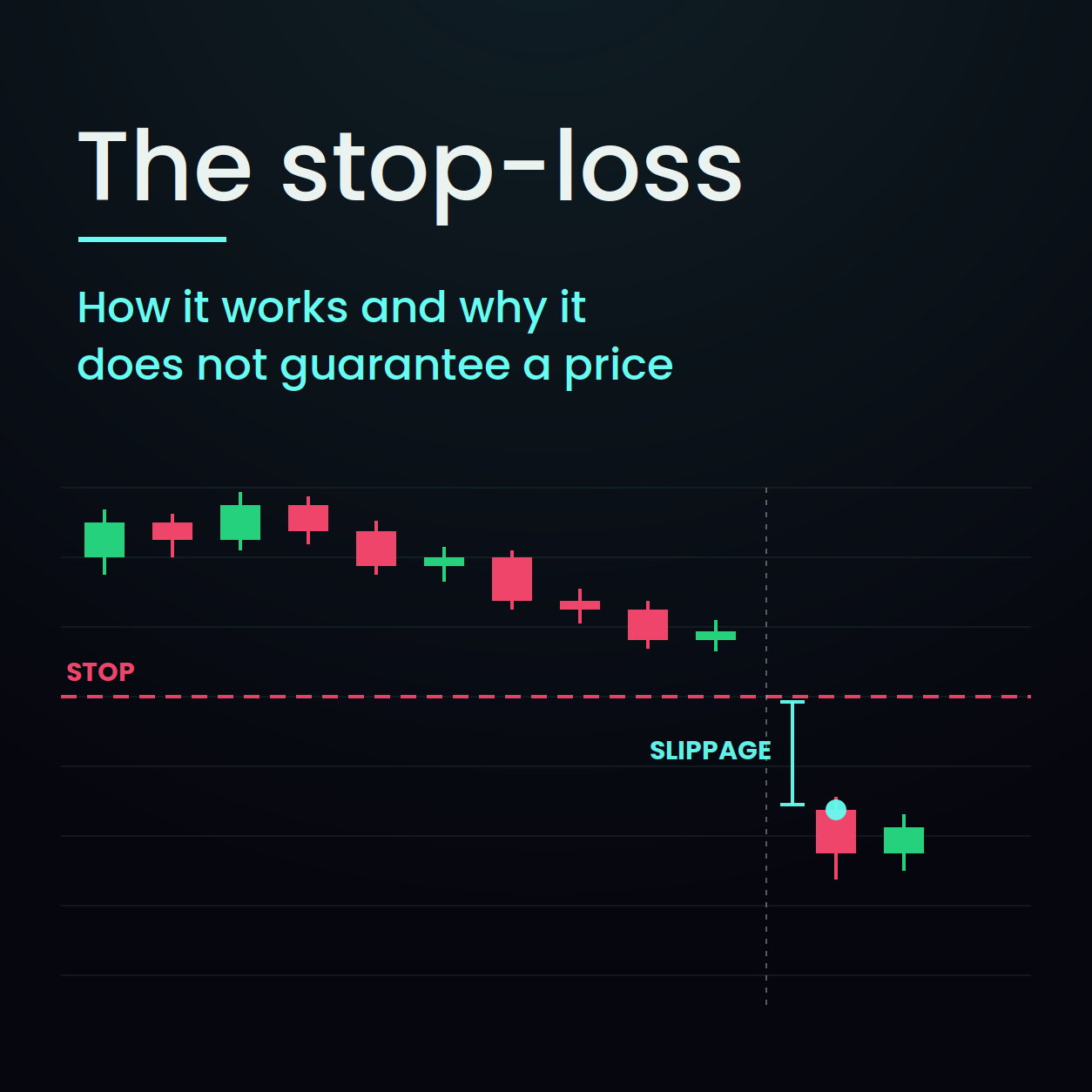
As long as price does not reach your stop, the order waits at the broker or the exchange and is invisible to the market. As soon as price trades at or through your trigger price, the stop turns into an ordinary market order. And a market order has only one goal: to be filled immediately, at the next available price.
Why there is no price guarantee
For your sell order to be filled, someone has to buy on the other side. In the order book, buy orders wait at different price levels, each with a certain size. Your market order takes these orders one after the other, starting with the best price. If the size at the first level is not enough, the rest is filled at the next level, and so on.
In a calm, liquid market the price levels are close together and there is enough size waiting at each of them. You are then filled almost exactly at your stop price. In a fast market the order book looks different: there may be no buyer left at your stop price at all, and several points lie between the levels. The difference between your stop price and the actual fill price is called slippage.
This is not a trick by the broker, but the mechanics of every market. A market order buys or sells liquidity, and liquidity is not unlimited. By the way, slippage can also work in your favour. With stop orders this is the exception, though, because they are triggered exactly when the market moves against you.
The most common causes of slippage
- Price gaps: Over the weekend, overnight or after a trading break, the market often opens far away from the last price. If your stop lies inside this gap, it is filled at the first available price, and that can be well below your stop.
- Economic data and central bank decisions: Ahead of jobs data, inflation figures or rate decisions, many market participants pull their orders from the book shortly before the release. Afterwards price jumps, and liquidity only returns gradually.
- Thin markets: At night, on holidays or shortly before the close, there is less volume in the market. Even normal order sizes then move price more.
- Clusters of stops: Many stops sit below obvious lows, above obvious highs and at round numbers. When they are triggered, a large number of market orders in the same direction hit the market at once. This accelerates the move and increases slippage for everyone whose stop is there.
- Large positions: The bigger your order, the more price levels in the order book it needs. For private traders this usually matters less than the other points.
An example in numbers
You buy the Nasdaq 100 at 21,000 and place your stop 40 points below at 20,960. Your account holds 10,000 euros and you risk 1% per trade, so 100 euros. That gives you a position size of 2.50 euros per point.
Shortly afterwards US inflation data comes out, the market falls fast and your stop is filled at 20,948. That is 12 points of slippage. Your loss is now 52 points times 2.50 euros, so 130 euros instead of 100 euros. 1 R becomes 1.3 R.
A single event like this is no drama. But if you are regularly in the market with a tight stop right before important data, slippage eats a noticeable part of your profits. So factor it into your risk.
Bid, ask and why you get stopped out although the chart never reached your stop
Every market has two prices: the bid, at which you can sell, and the ask, at which you can buy. The spread lies in between. A long stop is a sell order and is therefore triggered by the bid. A short stop is a buy order and is triggered by the ask.
In MetaTrader the chart shows only the bid by default. If you hold a short position, the ask can reach your stop while the candles in the chart stay well below it. This happens above all when the spread widens for a short time: around the daily rollover, when liquidity is lowest, and during important news. So switch on the ask line in MetaTrader and do not place short stops too tightly above highs.
The extreme case: the Swiss franc shock of 2015
On 15 January 2015 the Swiss National Bank unexpectedly removed its minimum exchange rate of 1.20 francs per euro. Within a few minutes EUR/CHF fell below 0.90 at times. On the way down there were practically no buyers. Stops placed just below 1.20 were in some cases filled hundreds of pips lower. Several brokers ran into trouble because many clients’ accounts went into deficit: Alpari UK became insolvent, and FXCM needed a rescue loan.
Events like this are rare, but they show clearly that a stop-loss limits your risk very reliably in normal market conditions. Against a real market shock, however, it is no shield. You can read more about such outliers in my article on the black swan in the stock market.
Stop-loss or stop-limit
- Stop-loss (stop-market): Turns into a market order once triggered. The fill is as good as certain, the price is not.
- Stop-limit: Turns into a limit order with a minimum price once triggered. The price is capped, but the fill is not certain. If the market jumps below your limit, your position stays open and the loss can keep growing. As protection for an open position, this is usually the worse choice.
A note for futures traders: at the CME, stop orders are not handled as pure stop-market orders but as “stop with protection”. Once triggered, the order enters the order book as a limit order with a certain range. This limits extreme fills, but in very fast markets it can also mean that part of the order is not filled at first.
Good to know: since 2018, retail clients in the EU trading CFDs have been covered by negative balance protection. Your account cannot fall below zero. This protects you from owing money to the broker, but not from losing all the capital you have deposited in an extreme case.
Where your stop should be
- Where your idea is wrong: Base your stop on market structure, i.e. beyond the last relevant high or low. A fixed distance in points that has nothing to do with the chart is pure chance.
- With some room: Do not put the stop exactly on the low or on a round number, but a few points beyond it. Exactly where everyone has their stop, slippage is greatest.
- Stop first, then size: The stop comes from the chart, the position size from your risk and the stop distance. Never the other way round. You can try out how this fits together in my trading simulator.
- Never widen it: Trailing a stop to lock in profits is fine. Moving it further away because price is getting closer never is. That undermines your entire risk management.
- No mental stop: A stop that only exists in your head does not protect you when the connection drops, you are distracted or the market is faster than you. Enter it as a real order, right with the entry.
What this means for you as a trader
- Expect slippage: Plan your risk so that a fill with some slippage is still acceptable.
- Know the economic calendar: Before every trade, check whether important data is due in the next few minutes, and decide consciously whether you want to be in the market for it.
- Watch out for weekends and holidays: Positions held over a trading break carry a gap risk that the stop does not cover.
- Keep an eye on the spread: Especially with short positions and around the daily rollover.
The stop-loss is not a price promise but an emergency exit. It opens reliably, but how tight it gets behind it is decided by the market. Once you understand this, you place your stops more deliberately and your fills no longer surprise you.
This article is for financial education and does not constitute individual investment advice or a trading recommendation.
Best wishes
Gabor