
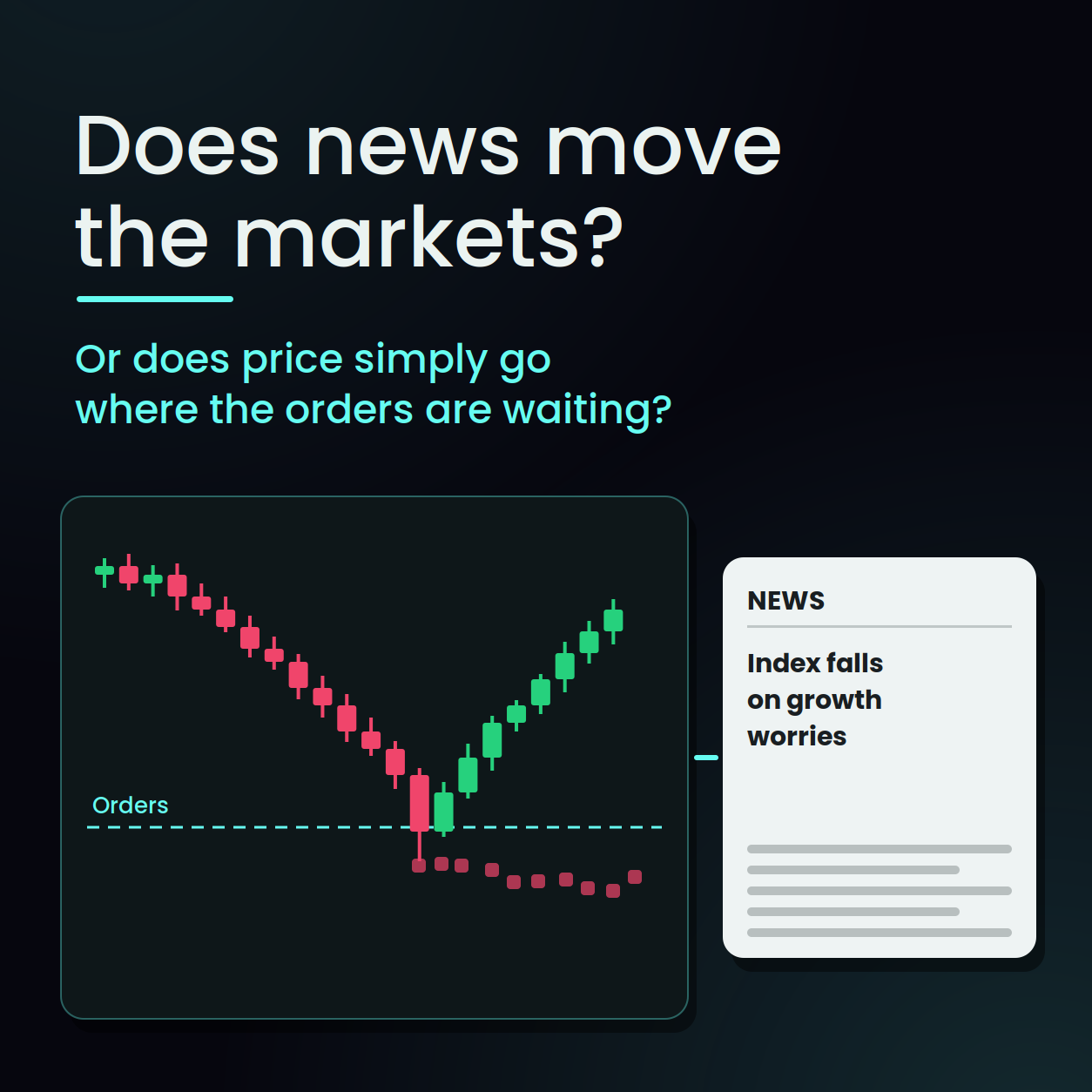
“The index falls on growth worries.” “Gold rises on a weaker dollar.” You read lines like these every evening. They sound logical, and sometimes they are true. But often the explanation is only found after price has already moved. Then it is not the news moving prices, but prices making the news.
In this post I show you both sides: when news really moves the market, and when price simply has to run to a level where orders are waiting to be filled. Once you know the difference, headlines unsettle you less and you understand better what is happening on the chart.
When news really moves the market
No question: important news and fundamental data move prices. A central bank rate decision, inflation figures, the US jobs report or an unexpected political event can move a market by hundreds of points in seconds and change the trend for days or weeks.
What matters is less the news itself than the surprise. The market trades expectations. If inflation comes in exactly as forecast, it is usually already priced in. Only a deviation from expectations triggers a real move. That is why a share sometimes falls despite good results: the market had expected even better ones.
You may know this as “buy the rumour, sell the news”. Before an expected event, people buy; once it happens, many take their profits. The good news is out, and price falls anyway.
When price runs to the orders
A market is an auction. For a price to form, someone has to buy and someone has to sell. At certain price levels, a particularly large number of orders build up: limit orders from traders who want to get in there, and stop orders from those who have to get out there.
In my exam as a licensed stock exchange trader I learned: price is formed by supply and demand. It settles where the greatest demand meets the greatest supply, with the smallest imbalance. This is known as the principle of maximum executable volume: the valid price is the one at which the most can be traded. That is exactly why price is drawn to the levels where many orders are waiting.
Typical levels are the previous day’s high and low, round numbers such as 20,000 points, prominent highs and lows of recent days, and the opening prices of important trading sessions. Right where many traders place their stop-loss, there is a lot of liquidity.
Large market participants need this liquidity. Anyone who wants to build a very large position cannot find enough counterparties at every price. Below a previous day’s low, however, many stop orders are waiting, in other words sell orders. If price runs there, they are triggered and the large buyer gets filled. Once the liquidity is used up, price often turns just as quickly as it came.
No new information is needed for the move to the level. The market is simply looking for orders. This is not a conspiracy but perfectly normal market mechanics: prices move to where trading can take place.
The explanation comes afterwards
Now comes the part that can make you smile. Financial media have to explain every day why the market moved. “Price ran to the stops below the previous day’s low” is not a good headline. So a suitable piece of news is found, and there always is one: a comment on interest rates, an economic figure, a statement by a politician.
It becomes particularly obvious when the same news has to explain both directions on the same day. In the morning the index falls “on rate worries”, in the afternoon it rises “despite rate worries” or “as bargain hunters step in”. And if nothing fits, it was simply “profit-taking”.
A typical day: the morning is quiet. At 14:30 CET, US data comes out pretty much in line with expectations. Even so, the index drops sharply shortly afterwards to just below the previous day’s low, triggers the stops and recovers by the evening. The next morning you read: “Growth worries weigh, afternoon recovery.” The data at most set the move in motion. The target was the level with the orders.
Both belong together
This is not an either-or. News often provides the trigger, and the orders determine how far the move runs. A surprise in the inflation figures can start a trend. An expected figure, on the other hand, is often just the starting signal for a move that wanted to go to a certain level anyway.
What this means for your trading
- Know the economic calendar. Important dates are known in advance. Decide consciously whether you want to hold a position at that time.
- Mark the price levels. The previous day’s high and low, round numbers and prominent highs and lows show you where price might run to, even without any news.
- Watch the reaction, not the headline. What matters is how price reacts at a level: does it break through, or does it turn once the stops are triggered?
- Don’t trade headlines after the fact. By the time the news is in the media, the move is usually over.
- Place your stop carefully. A stop right at the level everyone is watching is more easily taken out. Place it where your trade idea is no longer valid.
As a trader, the how matters, not the why
With everything you now know about news and orders: for you as a trader, the reason behind a price move is secondary. Whether the index falls because of growth worries or because price is taking out the stops below the previous day’s low makes no difference to your account. What matters is whether you have a plan and follow it.
So don’t ask yourself why questions, ask how questions:
- What is my setup?
- Has a setup formed in the direction of the move?
- How do I enter?
- How do I set my stop-loss?
- How do I manage the open position in profit?
- How do I exit?
Why questions are interesting if you want to discuss the markets or work as an analyst. When trading, they tend to distract you: if you first want to understand the reason, you enter too late, hold losses too long or trade a headline instead of your setup. The answers to the how questions, on the other hand, can be defined before every trade, and they are exactly what decides your result.
Frequently asked questions
Should I trade around major news?
That depends on your strategy. Around events such as rate decisions or jobs data, spreads widen and stops can be filled with slippage. Many traders therefore wait until the market has settled after the release.
Are stop hunts manipulation?
No. Markets look for liquidity, and it sits where many orders are. When price runs there, that is normal market mechanics and not a targeted action against you.
How can I tell where orders are?
In CFD trading you cannot see them directly. But the previous day’s high and low, round numbers and prominent highs and lows are where most traders place their entries and stops.
So are fundamentals unimportant?
No. They determine the big trends over weeks and months. In short-term trading, however, it is often the orders at price levels that decide where a move runs to and where it turns.
News moves markets, but not every move is caused by news. Once you understand that price often simply runs to where orders are waiting, you read the chart with different eyes and the headlines with a wink.
This article is for financial education only and does not constitute individual investment advice or a trading recommendation.
Best wishes
Gabor