
“The market is rigged.” You hear this a lot, usually after a loss. Market manipulation does exist, it is illegal and it is prosecuted. But it usually looks different from what many people think. Not every fast move and not every triggered stop is manipulation.
In this post I explain the most important techniques that regulators classify as market manipulation: what is behind them, how they work and how to recognise them. Plus a few well-known cases and, at the end, an overview of all the terms for reference.
What is market manipulation?
Market manipulation means deliberately influencing the price of a financial instrument or giving others a false picture of supply, demand or price. In the EU this has been governed since 2016 by the Market Abuse Regulation (MAR). At its core it distinguishes three types:
- False or misleading signals through orders and trades, such as fake orders or fictitious trades.
- Deceptive devices used to push a price to an artificial level.
- False information spread deliberately, for example rumours about a company.
Supervision lies with the national regulators, for example the FMA in Austria and BaFin in Germany, with the SEC in the US and, for futures, the CFTC. The exchanges also have their own surveillance units that analyse every order and every trade. Anyone caught faces heavy fines and, in serious cases, prison.
1. Deception in the order book
The order book shows how many buy and sell orders are waiting at which price. Many traders read from it where the market wants to go. That is exactly what these techniques exploit.
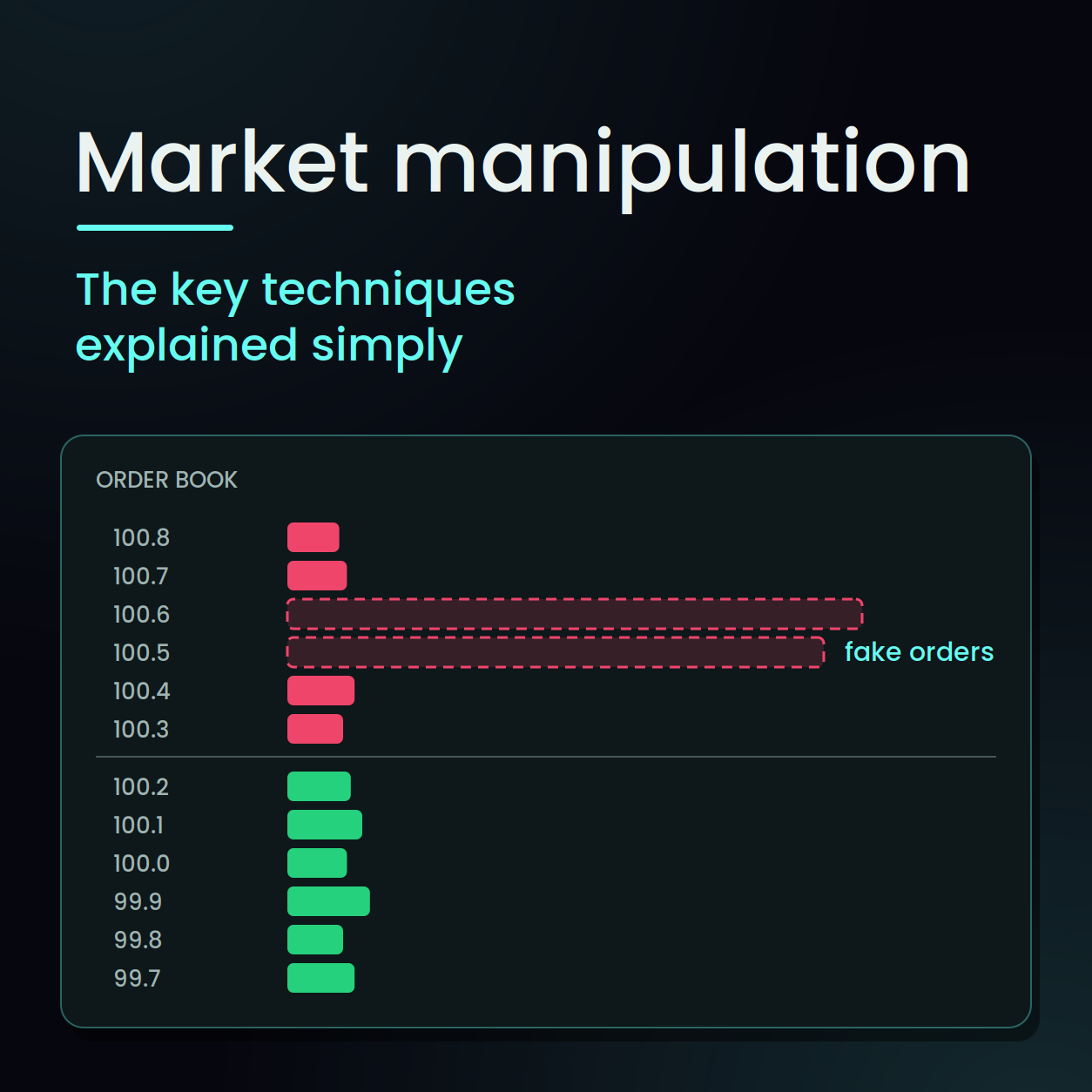
Spoofing: Someone places large orders they never intend to fill. A huge sell wall in the order book signals: there is plenty of supply here, price will fall. Other traders sell or pull their buy orders, and price gives way. The spoofer buys cheaply and cancels the fake orders before they are filled. The whole thing often takes only seconds.
Layering: The staggered form of spoofing. Instead of one large order, many orders are stacked on top of each other across several price levels. This makes one side of the order book look particularly heavy.
Quote stuffing: The market is flooded with an enormous number of orders that are cancelled immediately. This can slow down the data feeds and systems of other participants. Whoever is faster gains an advantage.
Momentum ignition: Targeted, aggressive buying or selling is meant to trigger a fast move. Other traders and algorithms jump on, price keeps running, and the initiator takes the profit.
Ping orders and phishing: Small test orders used to find out whether and where large hidden orders are sitting, for example in non-public trading systems. Once found, the trader gets ahead of them.
Smoking: Bait quotes at attractive prices that are changed quickly as soon as someone tries to react. The counterparty ends up trading at a worse price.
Advancing the bid: The bid is raised step by step to fake rising demand and push the price higher.
Well-known case: British trader Navinder Sarao traded the E-mini S&P 500 future from home and used a program for spoofing. US authorities held him partly responsible for the “Flash Crash” of 6 May 2010, when the US stock market plunged within minutes. Sarao pleaded guilty in 2016. Large banks have also been penalised for spoofing: in 2020 JPMorgan paid around 920 million US dollars over spoofing in precious metals and Treasury futures.
2. Fictitious trades
Here, trades actually take place, but without any real economic purpose. The aim is an artificial picture of volume, interest or price.
Wash trades: Buyer and seller are economically the same person. Nobody actually changes ownership; only volume is created. A market thus looks more active and liquid than it is. This is a known problem with small cryptocurrencies and on lightly regulated platforms.
Improper matched orders: Two parties agree on price and quantity in advance and then trade with each other. From the outside it looks like a normal market price.
Painting the tape: A series of trades creates the impression of lively activity or a trend. Other investors are meant to believe something is happening and buy in.
Marking the close: Buying or selling is targeted shortly before the close to influence the closing price. The closing price matters because it is used to value funds, settle derivatives and value portfolios.
Concealing ownership: Anyone building a large stake in a company must disclose it above certain thresholds. Front men or nested structures are used to hide this.
3. False information
This is the oldest form and the one that hits private investors most often. Today it runs mainly through social media, chat groups and newsletters.
Pump and dump: The initiators quietly buy a thinly traded share or cryptocurrency. Then they spread hype: “This stock will go up tenfold”, supposed insider information, paid recommendations. New buyers push the price up, and the initiators sell their holdings to exactly these buyers. Then the price collapses. The principle became famous through Jordan Belfort’s firm Stratton Oakmont, the inspiration for the film “The Wolf of Wall Street”.
Trash and cash: The opposite: negative rumours are used to push the price down. The initiators have sold short beforehand or buy cheaply afterwards. This is also known as “short and distort”.
4. Abusing market power
These techniques require a large position or financial clout. They are out of reach for private investors, but they explain some extreme moves.
Abusive squeeze and corner: Someone controls a large part of the supply of a commodity or security. Anyone who is short and has to deliver or cover can find no supply and has to pay any price. A historical example is the Hunt brothers, who bought up large quantities of silver in the late 1970s. The silver price rose sharply and collapsed in March 1980.
Price floor and ceiling: A price is artificially held within a range, for example below a certain level, so that options expire worthless or a threshold is not reached.
Cross-market manipulation: The price is influenced in one market to profit in another: for example in a share to profit from options on it, or on one trading venue to exploit another.
Collusion: Several market participants secretly coordinate to influence a price. This became known in benchmarks such as Libor, where banks had manipulated their submissions.
Excessive bid/offer spread: A participant with a dominant position deliberately keeps bid and ask far apart, making trading more expensive or making the market look illiquid.
What is not manipulation
As important as it is to know about manipulation: many things that feel like manipulation are perfectly normal market mechanics.
- Triggered stops: When price runs to the previous day’s low and triggers stops there, the market is looking for liquidity. That is normal market mechanics and not a targeted action against you.
- Algorithms and high-frequency trading: Most algorithms quote prices, hedge or execute large orders in small pieces. This is legal and often provides liquidity.
- Large orders: A fund that buys a lot moves the price. That is not deception but real demand.
- Fast moves after news: When the market reacts within seconds to a rate decision, that is information being processed, not manipulation.
What this means for you
- Trade through regulated brokers and exchanges. There is market surveillance there, and manipulation is prosecuted.
- Be suspicious of tips. If a share or coin is “guaranteed to explode” in chat groups, forums or private messages, that is a classic sign of a pump and dump.
- Avoid extremely small stocks. The lower the volume, the easier it is to move a price. Large indices such as the Nasdaq 100 are hardly manipulable because of their enormous liquidity.
- Read the order book with caution. Large visible orders can be real, but they do not have to be.
- Look for the cause in yourself first. A loss is almost always the result of entry, stop or position size, not manipulation. It is uncomfortable, but it is the only way to get better.
- Report genuine suspicions. National regulators such as the FMA in Austria accept reports of suspected market manipulation.
All terms at a glance
| Term | What happens | Type |
|---|---|---|
| Spoofing | fake orders cancelled before execution | Order book |
| Layering | fake orders across several price levels | Order book |
| Quote stuffing | flood of orders to slow other systems | Order book |
| Momentum ignition | trigger a move, others jump on | Order book |
| Ping orders / phishing | test orders to find hidden orders | Order book |
| Smoking | bait quotes changed quickly | Order book |
| Advancing the bid | raise the bid step by step | Order book |
| Wash trades | buying and selling to yourself | Fictitious trade |
| Improper matched orders | trades agreed in advance | Fictitious trade |
| Painting the tape | fake activity | Fictitious trade |
| Marking the close | influence the closing price | Fictitious trade |
| Concealing ownership | hide stakes | Fictitious trade |
| Pump and dump | create hype, then sell | Information |
| Trash and cash | spread rumours, then buy cheaply | Information |
| Abusive squeeze / corner | control supply, squeeze shorts | Market power |
| Floor / ceiling | hold price in a range artificially | Market power |
| Cross-product / inter-venue | profit in one market via another | Market power |
| Collusion | secret coordination | Market power |
| Excessive spread | keep the spread artificially wide | Market power |
Frequently asked questions
Is the Nasdaq or the DAX manipulated?
There have been individual cases of spoofing in large index futures, and they were uncovered and punished. Steering the direction of a major index over days is practically impossible because of the enormous volumes.
Is stop hunting manipulation?
When price runs to a level where many stops sit, that is the normal search for liquidity. It would only be manipulation if someone deliberately drove price there with fake orders or false information.
Can I recognise manipulation as a private investor?
Hardly reliably in the order book. With pump and dump, though, you can: unusual hype, aggressive buy recommendations, little-known stocks and sudden price jumps without real news are warning signs.
What happens to manipulators?
Regulators impose fines, claw back profits and ban people from trading. In serious cases there are criminal proceedings and prison sentences.
Market manipulation exists, and it is worth knowing the techniques, especially pump and dump, because it hits private investors most directly. In a trader’s day-to-day life, however, most things that feel like manipulation are perfectly normal market activity. If you can tell the difference, you protect your money and your nerves.
This article is for financial education only and does not constitute individual investment advice or a trading recommendation.
Best wishes
Gabor